
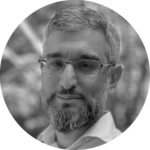
Dr Talal Al-Azem
Academic Director
As Academic Director of Cambridge Muslim College, Dr Talal Al-Azem heads the College’s academic programmes, leads in the development of curricula, and oversees research. He was educated at the University of Michigan and at Oxford, and studied the disciplines of Islamic learning in Syria and Turkey. Dr Al-Azem has served as fellow at the Oxford Centre for Islamic Studies and lecturer in the Faculties of Theology and Religion and of Oriental Studies at the University of Oxford. His research focuses on Muslim moral theology, law, and education.
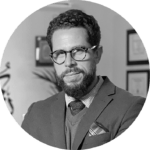
Dr Abdallah Rothman
Programme Lead, Islamic Psychology Diploma
Dr Abdallah Rothman holds an MA in Psychology from Antioch University and a PhD in Psychology from Kingston University London. His clinical practice as well as his academic research focus on approaching counselling and psychotherapy from within an Islamic paradigm and establishing an indigenous Islamic theoretical orientation to human psychology that is grounded in the knowledge of the soul from the Islamic tradition. In addition to his academic training he has studied privately with a number of traditional Islamic scholars throughout the Muslim world. Dr Abdallah is visiting professor of psychology at Zaim University Istanbul, International Islamic University Islamabad, and Al-Neelain University Khartoum and co-founder, along with Professor Malik Badri, of the International Association of Islamic Psychology.
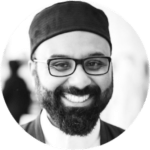
Dr Salman Younas
Programme Lead, BA (Hons) Islamic Studies
Dr Salman Younas’ research focuses on Islamic law in the classical and modern periods. Dr Younas graduated from Stony Brook University with a degree in Political Science and Religious Studies. After completing his undergraduate degree, he moved to the Middle East where he spent half a decade studying Arabic and the traditional Islamic sciences. In 2013, Dr Younas completed his MA in Oriental Studies from the University of Oxford with honours. He then went on to complete a DPhil in Oriental Studies from the University of Oxford in 2018. He was previously a researcher at the Oxford Department of International Development and the Hamad bin Jassim Fellow at the Oxford Centre for Islamic Studies.

Dr Ramon Harvey
Programme Lead, Research
Dr Ramon Harvey lectures in Islamic theology at Cambridge Muslim College. He undertook his postgraduate studies at SOAS, University of London, and also holds an ʿalimiyya qualification. His publications include monographs and articles in both Islamic theology and Qur’anic studies. Currently, his research focuses on kalām in early Māturīdism and on constructive Islamic theology, especially in conversation with Christian theology, analytic philosophy and phenomenology. He is Series Editor of Edinburgh Studies in Islamic Scripture and Theology, which is published by Edinburgh University Press.
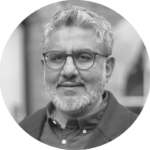
Dr Omar Qureshi
Programme Lead, Diploma in Contextual Islamic Studies & Leadership
Dr Omar Qureshi is a lecturer in Western and Islamic Philosophy and serves as the head of the Diploma in Contextual Islamic Studies & Leadership (CISLD) at Cambridge Muslim College. He earned his Bachelor of Arts in Microbiology and subsequently completed his M.Ed. in Curriculum and Instruction – Science Education, both from the University of Missouri – Columbia. Later, he earned his Ph.D. in Cultural and Educational Policy Studies with a specialization in the Philosophy of Education from Loyola University Chicago in 2016. His dissertation, titled “Badr al-Dīn Ibn Jamāʿah and the Highest Good of Islamic Education,” explores the topic of educational institutional identity in the United States. Before joining Cambridge Muslim College, he served as the provost and assistant professor of Liberal and Islamic Studies at Zaytuna College. Dr Qureshi also held the positions of principal and dean of academics at a parochial school located in the western suburbs of Chicago for seven years.
In the field of Islamic sciences, Dr Qureshi has studied various subjects, including Islamic Law (Shāfiʿī), Logic, Kalām theology, Islamic Philosophy, Islamic Legal Theory (usūl al-fiqh), Qurʾānic sciences and exegesis, Ḥadīth nomenclature, Prophetic Biography, and Islamic History.”
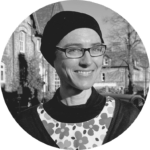
Dr Claire Gallien
Senior Research Fellow
Professor Claire Gallien is Senior Research Fellow at Cambridge Muslim College. She received her PhD in English and Comparative Literatures and Studies at the Sorbonne. She also has training in Arabic and Islamic Studies from the Inalco and abroad (Cairo, Damascus, Sanaa, Birzeit, Beirut, and Tunis). Prior to joining Cambridge Muslim College, she was research and teaching fellow at the Zentrum für Islamische Theologie (Tübingen University, Germany) and has had more than ten years experience of teaching and research at the University of Montpellier and the CNRS (France). Her research interests are in Islamic epistemology and Islamic intellectual and religious history, Islamic literature and Sufism, British early-modern orientalism, with a focus on the constitution of Islamic manuscript libraries in early-modern Britain, decolonial thinking and translation. She has studied with Muslim scholars in Egypt, Turkey and the UK.
Visiting Lecturers
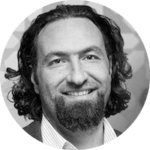
Dr Samir Mahmoud
Dr. Samir Mahmoud is currently Academic Director of Usul Academy. Recently he was Assistant Professor at the Lebanese American University. He has a BA (Hons) in Anthropology & Politics with a focus on multicultural theory and comparative religion, and an MA in Architectural History, Theory & Urban Design with a focus on the traditional townscape from the University of New South Wales, Sydney Australia. He also holds an MPhil in Theology & Religious Studies with a focus on comparative philosophy and aesthetics. He completed a PhD in Islamic Studies from the University of Cambridge.

Dr Wim Sulayman Van Ael
Visiting Lecturer
Dr. Wim Sulayman Van Ael, a distinguished academic, boasts a rich expertise in Islamic Sciences, Quran studies, and mental health. With a steadfast commitment to education, he serves as a dedicated educator, lecturer, and chaplain, earning recognition for his invaluable contributions to Islamic education, spiritual guidance, and mental health advocacy. Dr. Van Ael earned a Bachelor of Arts in Islamic Theology and holds a wealth of certifications, including Master NLP, Neuropsychology, CBT, and CBT based Mindfulness. In addition to his scholarly achievements, he is a practicing psychotherapist and proudly holds a Doctorate in Islamic Sciences from R. Sorbon, France. Throughout his career, Dr. Van Ael has held significant positions in various prestigious institutions, his influence, and impact are recognized globally, as evidenced by his consistent inclusion in the “500 Most Influential Muslims in the World” since 2017, under the category of Spiritual Guides.
Muhammad Husain Kazi
Visiting Lecturer
Muhammad Husain Kazi is a visiting lecturer at the Cambridge Muslim College where he teaches the Quranic Studies module. Muhammad serves as a Community Imam and Liaison Officer at Ashford and Staines Community Centre and is reading for a PhD in Theology and Religious Studies at the University of Cambridge. He is particularly interested in the theme of the Prophet’s exemplariness and the complex interplay between the temporal and timeless dimensions of the Qur’an. Muhammad completed an MSt at Oxford, an MA at SOAS, has spent more than a decade studying the Islamic sciences with traditional scholars in the UK and Jordan, and has also memorised the Noble Qur’an.
Dr Sohail Hanif
Associated Lecturer
Sohail Hanif works on Islamic legal theory, with a focus on the Ḥanafī school of law. He received a MA and DPhil from the University of Oxford. His doctoral thesis, A Theory of Early Classical Ḥanafism: Legal Epistemology in the Hidāyah of Burhān al-Dīn ‘Alī ibn Abī Bakr al-Marghīnānī (d. 593/1197), studies the interplay of rationality and tradition in a major work of legal commentary. Sohail has also spent over a decade in Jordan where he studied a full curriculum of Islamic sciences with traditional ‘ulamā’. He was previously Head of Arabic Sciences at Qasid Arabic institute in Amman, an instructor in Islamic studies at Qibla online academy, and has taught undergraduate classes on Modern Islam and Qur’anic studies at the University of Oxford. He has also served as Head of Research and Development at the National Zakat Foundation.